Sunday, November 24, 2013

Event Blog No.1 LA Auto Show

This weekend, my friend and I came to LA Auto show in downtown LA. I'm really glad to know from professor that this event can be counted as one for our class! The large event held in Convention center has more than 100 years history, and is now the world's most influential and most attended auto show. Yesterday was the second day of the event. I saw automobiles as the most close and practical example of interaction of arts and technology even before I attend this course. Especially in the U.S., the cars are part of people's life. As cars were invented as a transportation tool at first, people started to customize their cars in order to show their uniqueness and personality. Therefore, auto makers provided strong financial support in designing their cars and differentiate from the others. 
My favorite auto maker is Audi, one of the "German big 3", along with BMW and Mercedes-Benz. Besides its fame in reliability and quality, I enjoy its design, both interior and exterior. With its arresting lines of their signature Singleframe grille plus the distinctive LED daytime running lights, I just felt obsessive to it! The application of technology into an artistic looking is the key factor of Audi's long-lasting fame all over the world.
2014 Audi S8
2014 Audi A7 TDI and Me!
There were many other beautiful cars and some of them are really astonishing at first glance. However, I don't want this post to be an auto gallery, thus the next part I want to discuss the unity of appearance and target group.
Smart Fortwo
Lamborghini
Red Bull RB6
Three typical cars I found in the show. Small, lovely Smart, exotic pre-owned Lamborghini and the legendary Red Bull RB6. Smart was designed as a two seater city car, and the cute exterior was primarily manufactured to attract female and youngster who prefer less consumption and tight interior. The second is an exotic pre-owned Lamborghini. Look at the way it opened its doors and the matt pink body! It would attract everyone's attention before the driver steps out. Both impressive designs with high artistic value are designated to attract the potential owners. The auto makers have already predicted the preference and personality of its future owner. Lastly, the formula one racing car was all designed for better performance and almost no artistic consideration at all. Therefore, one can see how different are designs of various kinds of cars!
This annual celebration of auto lovers is now in LA! If you love cars or are interested in technology, you should definitely take a look! 

Work Cited
"About Us | LA Auto Show." LA Auto Show RSS. 2013 LA AUTO SHOW, n.d. Web. 24 Nov. 2013. <http://laautoshow.com/about-us/>.
"Audi." Wikipedia. Wikimedia Foundation, 24 Nov. 2013. Web. 24 Nov. 2013. <http://en.wikipedia.org/wiki/Audi>.
"Exterior Design." Audi Design: Car Designs. Audi of America, n.d. Web. 24 Nov. 2013. <http://www.audiusa.com/innovation/design/exterior-design>.
"Red Bull RB6." Wikipedia. Wikimedia Foundation, 11 July 2013. Web. 24 Nov. 2013. <http://en.wikipedia.org/wiki/Red_Bull_RB6>.
"Smart Fortwo." Wikipedia. Wikimedia Foundation, 18 Nov. 2013. Web. 24 Nov. 2013. <http://en.wikipedia.org/wiki/Smart_Fortwo>.

Week8 Assignment: NanoScience&Art

This week's topic is nanoscience and art. Since our professor has been working on it for over ten years, we had a very detailed, comprehensive lecture about this subject. We started with the scaling of nanoscience, which is measured by nanometer(10^-9 meter). Like we learned in physics class, when an object reduce to the size of nanometer, the Newtonian laws are no longer effective; instead, scientists find quantum mechanism apply to that scale. Inspired by Richard Feynman, precedents in this promising subject found the deterministic feature of quantum objects, which explored the large potential for scientists later to work on. In the lecture, professor Gimzewski gave a very specific introduction of nanotechnology in many aspects, such as the allotropes of Carbon, the Scanning Tunnel Microscope invented by Gerd Binning and  Heinrich Rohrer, and the application of this method that changes the physical property of a molecule in nanoscale level. However, since our focus should be on the interaction with art, I'd like not to discuss too much about it.
I realized human beings have been using nano-particles for a very long time. The Lycurgus Cup, probably made in Rome in 4th century AD, exhibited different colors under different conditions. Known as dichroic, the glass contains nano-sized gold and silver that display red and green when light passes from different direction, respectively.
The Lycurgus Cup

Another amazing feature of nano-particles is the self-organization and self-assembly. As we acquired the technology to manipulate nano-particles and concluded the quantum laws of it. Several objects Belousov Zhabotinsky reaction. It is an classical example of non-equilibrium thermodynamics, and displays perfect harmony of motion and stability. Resulting in the Oscillating Chemical reactions, the particles are reacting with each other back and forth in a very long time, therefore creates such effect.
Belousov–Zhabotinsky reaction
The Marangoni effect is another example, which is less complex but display similar feature. Due to the surface tension gradient, two fluids are transferring up and down, which creates the visual effect of "tears" of wine in the case of alcohol and water. Besides, I found a very interesting experiment using Marangoni effect that creates a soap propelled boat.

The Marangoni Effect: How to make a soap propelled boat!

Work Cited
"Belousov–Zhabotinsky Reaction." Wikipedia. Wikimedia Foundation, 17 Nov. 2013. Web. 24 Nov. 2013. <http://en.wikipedia.org/wiki/Belousov–Zhabotinsky_reaction>.

Gates, Sara. "Lycurgus Cup." The Huffington Post. TheHuffingtonPost.com, 27 Aug. 2013. Web. 24 Nov. 2013. <http://www.huffingtonpost.com/2013/08/27/lycurgus-cup-ancient-romans-nanotechnology_n_3818512.html>.

"Marangoni Effect." Wikipedia. Wikimedia Foundation, 30 Oct. 2013. Web. 24 Nov. 2013. <http://en.wikipedia.org/wiki/Marangoni_effect>.

"The Scanning Tunneling Microscope." The Scanning Tunneling Microscope. Nobel Media AB 2013, 1986. Web. 24 Nov. 2013. <http://www.nobelprize.org/educational/physics/microscopes/scanning/>.

Zhabotinsky, Anatol M. "Belousov-Zhabotinsky Reaction." Scholarpedia. Scholarpedia, 11 Sept. 2007. Web. 24 Nov. 2013. <http://www.scholarpedia.org/article/Belousov-Zhabotinsky_reaction>.


Sunday, November 17, 2013

Week7 Assignment: NeuroScience&Art

This week's topic is about neuroscience. In the lecture video, professor introduced how human recognition of brain and mind evolves overtime. From Aristotle's perspective that "seat of human thought and emotion was the heart. Brain cools blood and prevent heart and lung from becoming overheated" to Franz Joseph Gall's practice of phrenology and effort to localize the mental functions of brain, it takes almost two thousand years for human beings to treat neuroscience as an individual subject. Later, Santiago Ramon y Cajal, the Spanish neuroscientist, who investigated the structure of nervous system, drew map of the delicate brain cells and was considered the father of neuroscience. 
Neurons by Santiago Ramón y Cajal

Throughout the all lecture videos for this week, the Brainbow process is the most surprising part to me. I have been used to the pictures and models in textbooks and laboratories about neurons, which is monochromatic and connected by lines. However, the Brainbow distinguished nearby neurons using fluorescent proteins. The colorful pictures of neurons taken under this process are both beautiful in artistic perspective and effective for scientific researches. I also found some pictures online--not only the human neurons, but also mice!
By Tamily Weissman, Jean Livet, and Jeff Lichtman, Harvard University


By Alain Chédotal and Linda J. Richards

In the second part, professor asked about dreams, which is still mysterious to scientists, but we have been trying to understand it by studying our mind. Sigmund Freud divided mind into conscious and unconscious and then further separates into id (instincts or drive) and superego (conscience). There are many controversy between him and Carl Gustav Jung, who divided unconscious into personal and collective and treat religion in a positive light while Freud didn't believe so. 

Although we still know little about dream in laboratory, there are many great movies in the cinemas. Mulholland Drive, an American surrealist neo-noir film, categorized as psychological thriller, written and directed by David Lynch, mixed reality and dreams to the awake audiences. 
In 2010, Christopher Nolan also made a science fiction movie inception, introducing the idea of "dream stealers."


Mulholland Drive Trailer


Inception Traler

Work Cited

"Brainbow." Wikipedia. Wikimedia Foundation, 09 May 2013. Web. 17 Nov. 2013. <http://en.wikipedia.org/wiki/Brainbow>.

"Santiago Ramón y Cajal - Biographical". Nobelprize.org. Nobel Media AB 2013. Web. 17 Nov 2013. <http://www.nobelprize.org/nobel_prizes/medicine/laureates/1906/cajal-bio.html>

Straub, Julian. "Notes: Advice for a Young Investigator by Santiago Ramón Y Cajal." Julian Straub. Julian Straub.de, 21 July 2013. Web. 17 Nov. 2013. <http://www.jstraub.de/notes-advice-for-a-young-investigator-by-santiago-ramon-y-cajal/>.

Vesna, Victoria. "Neuroscience-pt1.mov." YouTube. YouTube, 17 May 2012. Web. 17 Nov. 2013. <https://www.youtube.com/watch?v=TzXjNbKDkYI>.


Weissman, Tamily. "Cell - Cell_picture_show-All-Stars." Cell Press. Elsevier Inc., n.d. Web. 17 Nov. 2013. <http://www.cell.com/cell_picture_show-All-Stars>.

Saturday, November 9, 2013

Week6 Assignment: Biotech and Art

This week's topic is the most controversial one so far. Biotechnology, a powerful and mysterious science from the perspective of public, is facing severe limits and doubts nowadays. As a pioneer in exploring new and exciting area, artist has first stepped in it and exhibited to the public in their own ways. 
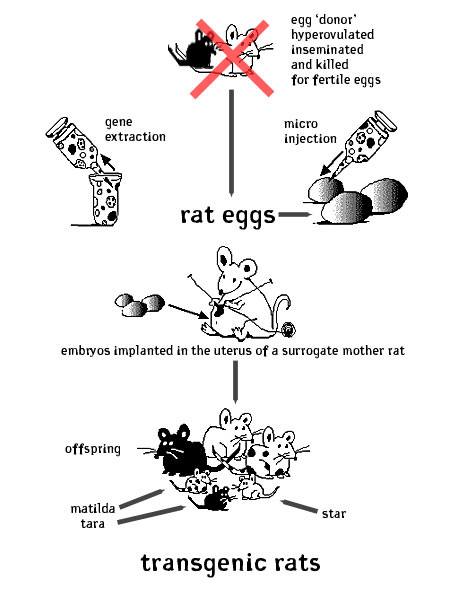
Kathy High, the Associate Professor of Department of Arts of Rensselaer Polytechnic Institute is one of them. Like many other artists, she makes rat as her friend. Technologically, this small animal is close relative to humans in tree of revolution; morally and historically, its nocturnal habits and notorous name as a pest makes it easier for human beings to accept the "scary" experiment on it. Kathy inserted foreign DNA into regular rats. Therefore, some non-rat features have been displayed on its offsprings, which is called the transgenic rats. 

The choice of gene are chosen by human, depending on the goal of the experiment.  For example, In the picture above, rats could release many eggs, which would never happen on wild rats. Some others chose to give them fluorescent gene--Green fluorescent protein DNA, then the baby rats would become green under ultraviolet light, this was done by researchers in University of Pennsylvania. 
Photograph courtesy University of Pennsylvania
Artists are not satisfied with applying this amazing science only to small animals like rats. The famous Harlequin Coat by French artist Orlan, composed by various skin from different color, age and sex, develops the idea of crossbreeding and hybridization. Afterwards, a questions rise to the public: can skins of different color be cultivated?
There are a lot more artworks combining biotechnology and art, like "the third eye" by Stelios Arcadiou. Seriously, I can't look at the picture for too long because such implanted "artwork" makes me sick. However, I'm not in the opposite position of their rights of doing so. Some critics blame this method are driving against the natural law. But I would argue that, as long as the nature makes it possible to do so, there is nothing "unnatural" of it. The biotechnology should definitely being controlled and tested carefully because of the unpredictable nature of the experiment. I would expect inspiring advances and amazing artworks to be created in the future, but I sincerely hope we treat it fairly and carefully.

Work Cited
Combs, Chris. "Glowing Animals: Beasts Shining for Science." Nationalgeographic.com. Nationalgeographic, 14 May 2009. Web. 9 Nov. 2013. <http://news.nationalgeographic.com/news/2009/05/photogalleries/glowing-animal-pictures/?rptregcta=reg_free_np&rptregcampaign=20131016_rw_membership_n1p_us_se_w#/rats-mice-glowing-animals_11838_600x450.jpg>.

High, Kathy. "Embracing Animal :: All About Transgenic Rats." Embracing Animal :: All About Transgenic Rats. Embracinganimal.com, n.d. Web. 10 Nov. 2013. <http://www.embracinganimal.com/transrats.html>.

High, Kathy. "Kathy High: Visual/media Artist, Independent Curator, Educator." Kathy High: New Media Artist: Full Biography. Http://kathyhigh.com/, n.d. Web. 10 Nov. 2013. <http://kathyhigh.com/longbio.html>.

Orlan. "Bio-art." ORLAN OFFICIAL WEBSITE SITE OFFICIEL DORLAN RSS. ORLAN Studio, n.d. Web. 10 Nov. 2013. <http://www.orlan.eu/works/bio-art/>.

"Still, Living." Still, Living. SymbioticA, n.d. Web. 10 Nov. 2013. <http://www.stillliving.symbiotica.uwa.edu.au/pages/artists/orlan.htm>.


Sunday, October 27, 2013

Week4 Assignment: Medtech and Art

This week's topic is Medicine, technology and art. An essential interaction of art and medicine is the study of human bodies. And the body dissection is the starting point of everything involved. In ancient Rome and most other civilizations, dissection of human body is heavily forbidden because the tradition, religion reasons. Therefore, the progress of dissection is pretty slow at that time (Arthur). Finally at the late 13th century, increasing number of human body dissections started to show up. And artworks about this controversial study recorded this significant progress. 
Fascicolo di medicina

After improvement in the understanding of human body structure, the painting and sculpture of human started to flourish. Some famous artworks still maintain precious aesthetic value. Like the masterpiece David (1501-1504), which revolutionized previous impression people have about the Biblical hero. The significance of this sculpture is challenging the previous opinion of man with trapped soul but being rational, beautiful and heroic--worthy of happiness and capable of great achievement (Sandstead). 
Michelangelo di Lodovico Buonarroti Simoni

After acquiring necessary knowledge of body structure, people has the reasonable provision discovering ways to change it. During World War One, plastic surgery emerged as large number of wounded people need to be saved by cutting their body parts or repair their skins and muscle. Later as the war ended, this skill has been applied to art and commerce. A artistic example would be Skin trade by Martha Wilson and Larry List. The perception of skin has shifted from "universal solitary confinement" to "a marker of identity" to "a means of communication"(Colucci). Although I don't really appreciate the way these artists express themselves, it is a revolutionizing and impressive approach. 
Exhibition : from the 20th of June to the 20th of July 2013
SKIN TRADE


Reference

Aufderheide, Arthur C. The Scientific Study of Mummies. Cambridge, UK: Cambridge UP, 2003. Print.
Colucci, Emily. "Filthy Dreams." Filthy Dreams. N.p., 30 June 2013. Web. 27 Oct. 2013. <http://filthydreams.wordpress.com/2013/06/30/transcend-the-skin-youre-in-at-p-p-o-w-s-skin-trade/>.
Ketham, Johannes De. Fascicolo Di Medicina. 1493. The Metropolitan Museum of Art, New York. The Dissection. Venice: Johannes and Gregorius De Gregoriis, 1493. N. pag. Print.
Lodovico Buonarroti Simoni, Michelangelo Di. David. 1504. Galleria Dell'Accademia, Florence.
Sandstead, Lee. "The Meaning of Michelangelo's "David"" The Meaning of Michelangelo's "David" Sandstead.com, 5 Sept. 2004. Web. 27 Oct. 2013. <http://www.sandstead.com/essays/david.html>.
Wilson, Martha, and Larry List. Skin Trade. 2013. P.P.O.W, New York CIty. Orlan. Orlan.net, 8 July 2013. Web. 27 Oct. 2013. <http://www.orlan.eu/>.

Sunday, October 20, 2013

Week3 Assignment: Robotics and Art

The topic of this week is robot, but not only robots nowadays or in the future, professor traced the history of robotic history. One popular point of view by Walter Benjamin towards machine and robotics is that Mechanical reproduction destroy uniqueness, culture and even tradition: it eliminates the aura of original artwork, written in his famous paper The Work of Art in the Age of Mechanical Reproduction (Ch2). Now I realized human has been long imagining the interaction with machine with both curiosity and scare (Part3). However, I don't think development of robotics and machine would damage our culture and art, but generating new ground for art and imagination. People are now creating human-like robots, or the "friendly-looking" robots as described by Japanese professor Machiko Kusahara, since in this way, people won't get scared and may the robotics be part of human life.

One influential application of these kinds of robots is Japanese Animation. While animation gives enough freedom for artists, the success reflects the promising expectations that we have about robotics. I would give one example here--Doraemon. Doraemon is a robotic cat that comes from the 22nd century. He comes to 20th century and stays with Nobi Family. Doraemon always help the Nobis with the devices from 22nd century(IMDb). They made great friends with each other. In the animation, the robotics can sleep, eat, think and have emotions that a human possesses but have incredible devices, cute appearance and machine-like problems.


Doraemen Poster


Human-like appearance and emotions

Doraemen Theme Song


Reference

Benjamin, Walter. "Two." The Work of Art in the Age of Mechanical Reproduction. Trans. Andy Blunden. N.p.: Zeitschrift Für Sozialforschung, 1936. N. pag. The Work of Art in the Age of Mechanical Reproduction. UCLA School of Theater, Film and Television, Feb. 2005. Web. 20 Oct. 2013. <http://www.marxists.org/reference/subject/philosophy/works/ge/benjamin.htm>.

"Doraemon." IMDb. IMDb.com, n.d. Web. 20 Oct. 2013. <http://www.imdb.com/title/tt0069576/>.

Doraemon Theme Song. Prod. Kan Sawada. Perf. Kazuyo Aoki. Shin Ei Animation, 1979. YouTube. YouTube, 17 Apr. 2008. Web. 20 Oct. 2013. <http://www.youtube.com/watch?v=_l-r7_f0CVs>.

Kusahara, Machiko. "Robotics Machiko Kusahara." Interview. YouTube. Uconlineprogram, 14 Apr. 2012. Web. 20 Oct. 2013. <https://www.youtube.com/watch?v=xQZ_sy-mdEU>.

Vesna, Victoria. "Robotics Pt3." Lecture. YouTube. YouTube, 16 Apr. 2012. Web. 20 Oct. 2013. <https://www.youtube.com/watch?v=wkP7oSZVkbg>.

Saturday, October 12, 2013

Week2 Assignment: Math and Art


As a junior student majoring in Math/Econ, I was very glad to see the topic of this week! Mathematics eventually gained an approach to stay closer to the real world! It has been a long time that people consider Mathematics and people who study it as arcane and sophisticated while the art department, which is located in the far north of the campus, is usually none-related to math. As several points presented in Professor's lecture, I found the perspective to be the most direct interaction between math and art. Mathematician is not creating features but discovering facts. While we compare the paintings before and after Renaissance, we would see the clear difference in displaying objects since painters don't have the knowledge of projecting 3D object into 2D canvas (Aliar). Besides, the content starts to contain ordinary people instead of religious images. Therefore, the application of perspective in artwork shifted the paradigm of human aesthetic vision.


Madonna and Child (c.1300)


Young Woman With Unicorn. 1506

Besides the application of perspective, there are a lot more links between art and math, like the golden ratio, dimension. Even the technology of computer is heavily based on mathematical calculation, which is prevalently used in modern artwork.


Furthermore, there is a point of view stayed in my mind that mathematical formulas itself are artworks, some of them are even masterpiece! One famous example is Euler's Formula:


It was discovered in 1748 by Leonard Euler (1707 - 1783). No one could tell how it was created, maybe only god can interpret it. an equation connecting the fundamental numbers i, pi, e, 1, and 0 (zero), the fundamental operations +,* , and exponentiation, the most important relation =, and nothing else (Weisstein). I don't know what non-math major student see from this formula, but it gives me the same enjoyment of beauty and impression those amazing painting and sculpture has given me. It is a perfect union of the simple numbers, just like the great mountain combined every elements in the nature world.


I don't separate art and math as individual subject, but a different focus in discovering the world. Everything that inspires me and brings me the enjoyment of beauty would be considered an artwork to me, including the formulas and numbers that do so.


Reference


Aliar. "19 | November | 2012 | Alia's Site." Alias Site. IICS, 19 Nov. 2012. Web. 12 Oct. 2013.           <http://aliar.iics-k12.com/2012/11/19/>.
Buoninsegna, Duccio Di. Madonna and Child. 1300. Greatest paintings of the Medieval era.             The Stroganoff Madonna New York Metropolitan Museum of Art, New York CIty.
"Duccio Di Buoninsegna (c.1255-1319)." Duccio Di Buoninsegna: Sienese Painter, Maesta                Altarpiece. Visual-arts-cork.com, n.d. Web. 12 Oct. 2013. <http://www.visual-arts-                    cork.com/old-masters/duccio-buoninsegna.htm>.
Da Urbino, Raphael. Young Woman With Unicorn. 1506. Oil Paint. 65 cm × 61 cm. Galleria            Borghese.http://en.wikipedia.org/wiki/Young_Woman_with_Unicorn. 12, 10, 2013.
Weisstein, Eric W. "Euler Formula." From MathWorld--A Wolfram Web Resource.                         http://mathworld.wolfram.com/EulerFormula.html